


Table of contents
- Quick answer: what is a good patient acquisition cost for dentists?
- How to calculate patient acquisition cost
- Industry benchmarks by channel
- SEO vs. PPC vs. social: acquisition cost comparison
- Lifetime patient value: the number that changes everything
- ROI by marketing channel
- Reducing patient acquisition cost: practical tactics
- Tracking and attribution setup
- Budget allocation based on PAC
- Related reading
What does it cost you to acquire a new patient? If you hesitated, that’s the problem. In my experience, fewer than 20% of practice owners know this number.
A practice owner in Dallas told us she was “doing great on marketing” because she was spending $6,000/month and getting “a lot of calls.” When we asked how many of those calls became patients and what each patient cost to acquire, she didn’t know.
After three months of tracking and reallocation, her patient acquisition cost dropped to $142. Same total budget. Sixty-three percent more new patients. The difference was knowing the numbers.
Patient acquisition cost (PAC) is, the single most important metric for dental practice marketing. It tells you exactly how much you’re paying to get each new patient in the door - and which channels are actually worth your investment. This guide is about measurement, benchmarking, and budget reallocation specifically. For the broader multi-channel strategy, pair it with Dental Practice Marketing Strategies That Drive New Patients in 2026.
Reference points used in the tracking sections include Google Analytics 4 acquisition reporting, Google Ads conversion tracking setup, and Google Business Profile performance reporting.
Quick answer: what is a good patient acquisition cost for dentists?
| Practice type | Average PAC | Good PAC | Excellent PAC |
|---|---|---|---|
| General dentistry | $150-$300 | $100-$150 | Under $100 |
| Cosmetic-focused practice | $200-$500 | $150-$250 | Under $150 |
| Specialty (implants, ortho) | $250-$600 | $175-$300 | Under $200 |
| New practice (first 2 years) | $200-$400 | $150-$250 | Under $175 |
These ranges assume a healthy mix of marketing channels. Practices that rely entirely on Google Ads will have a higher PAC. Practices with mature SEO and strong referral systems will have a lower PAC.
Key takeaway: The average dental patient acquisition cost is $150-$300, but well-optimized practices consistently achieve under $150. Knowing your PAC by channel is the first step to reducing it.
How to calculate patient acquisition cost
The formula is simple. The discipline to track it is the hard part.
Basic PAC formula
Patient Acquisition Cost = Total Marketing Spend / Number of New Patients Acquired
Example:
- Monthly marketing spend: $5,000
- New patients acquired: 30
- PAC: $5,000 / 30 = $167 per patient
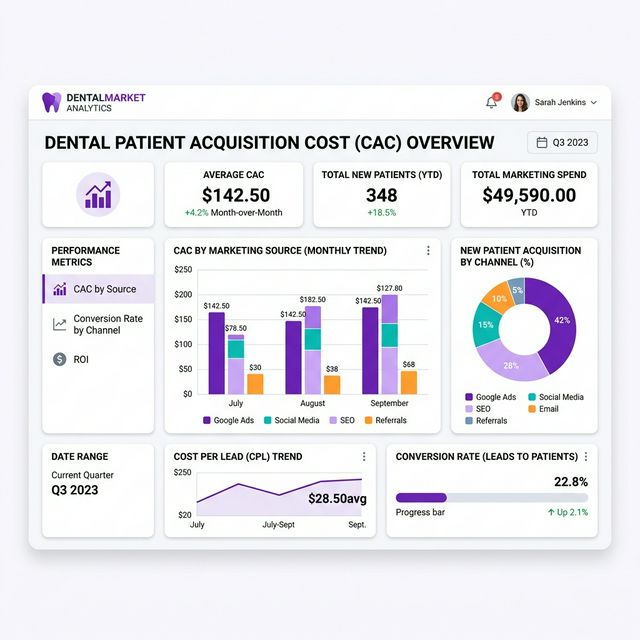
PAC by channel (the number that actually matters)
The blended PAC above is useful for a high-level view, but the channel-level PAC is where the real optimization happens.
| Channel | Monthly spend | New patients attributed | PAC per channel |
|---|---|---|---|
| Google Ads | $2,500 | 10 | $250 |
| SEO/Organic | $1,500 | 12 | $125 |
| Referral program | $300 | 5 | $60 |
| Social media ads | $700 | 3 | $233 |
| Total | $5,000 | 30 | $167 (blended) |
Now the picture is clear: the referral program produces patients at $60 each, organic SEO at $125, while Google Ads and social media are 2-4x more expensive. This doesn’t mean you should cut Google Ads - it means you should understand why and optimize accordingly.
What to include in “marketing spend”
Most practices - and I’ve worked with enough to say this confidently - undercount their marketing spend, which makes their PAC look lower than it actually is. Include everything:
| Cost category | Examples | Often missed? |
|---|---|---|
| Ad spend | Google Ads, Facebook Ads, Instagram Ads | Rarely missed |
| Agency fees | SEO agency, PPC management, social media management | Sometimes missed |
| Software | CRM, email marketing, review management, call tracking | Often missed |
| Content creation | Blog posts, video production, photography | Often missed |
| Staff time | Front desk time on marketing tasks, social media posting | Almost always missed |
| Referral rewards | Gift cards, credits, whitening treatments given as referral incentives | Sometimes missed |
| Print/community | Direct mail, sponsorships, event materials | Rarely missed |
Key takeaway: Calculate PAC by channel, not just blended. Include all marketing costs - agency fees, software, staff time, and referral rewards. The real number is usually 30-50% higher than what most practices calculate because they miss indirect costs.
Industry benchmarks by channel
Here’s what dental practices, typically pay per new patient by marketing channel in 2026, based on industry data and our client experience.
| Channel | Cost per new patient | Patient quality | Scalability |
|---|---|---|---|
| Patient referrals | $30-$80 | Highest (pre-trusted) | Limited (depends on patient base) |
| Organic SEO | $50-$125 | High (intent-driven) - run a Local SEO Audit | High (compounds over time) |
| Google Business Profile | $25-$75 | High (local intent) | Medium (GBP + SEO overlap) |
| Google Ads (PPC) | $150-$350 | Medium-high (intent-driven but ad-aware) | High (scales with budget) |
| Facebook/Instagram Ads | $100-$250 | Medium (awareness, not always intent) | Medium |
| Direct mail | $200-$500 | Low-medium (untargeted) | Medium (scales but response rates declining) |
| Community/sponsorships | Hard to measure directly | Medium (brand awareness) | Low |
Why the range is so wide
The PAC range for the same channel varies based on:
- Market competition: A dentist in Manhattan pays more per Google Ads click than one in a small Midwest town.
- Website conversion rate: Same traffic, different conversion - a 5% conversion rate halves your PAC compared to 2.5%. (Consider a Website Redesign if your site is underperforming.)
- Front desk phone skills: 30-40% of dental marketing leads are lost to poor phone handling (unreturned calls, unhelpful responses, no appointment offered).
- Service mix: Implant patients cost more to acquire but are worth 5-10x more over their lifetime.
- Review profile: Practices with 200+ strong reviews convert more searchers into patients at the same traffic level.
Key takeaway: Your website conversion rate and front desk phone handling can halve or double your patient acquisition cost without changing your marketing budget. Fix these before increasing ad spend.
SEO vs. PPC vs. social: acquisition cost comparison
This is the question we hear most from dental practice owners: “Where should I spend my marketing budget?” The answer depends on your timeline and growth goals.
See where your organic presence stands. Run your free local SEO audit →
Side-by-side cost comparison (12-month view)
| Factor | SEO | Google Ads (PPC) | Social media (paid) |
|---|---|---|---|
| Monthly investment | $1,500-$3,500 | $1,500-$5,000 | $500-$2,000 |
| Time to first patient | 3-6 months | 1-2 weeks | 2-4 weeks |
| Cost per patient (month 1-3) | Infinite (no patients yet) | $200-$400 | $150-$300 |
| Cost per patient (month 6-9) | $100-$200 | $175-$350 | $125-$250 |
| Cost per patient (month 12+) | $50-$125 | $150-$350 (stays constant) | $100-$250 (stays constant) |
| Compounds over time? | Yes | No | No |
| Stops producing when you stop spending? | No (results persist for months) | Yes (immediately) | Yes (immediately) |
The compounding math that matters
Here’s why SEO is the most cost-effective channel long-term, even though it’s more expensive per patient in the first few months:
Google Ads over 12 months:
- Monthly spend: $3,000
- Patients per month: 10 (consistent)
- Total spend: $36,000
- Total patients: 120
- Blended PAC: $300
SEO over 12 months:
- Monthly spend: $2,500
- Patients months 1-3: 0, 2, 5
- Patients months 4-6: 8, 10, 12
- Patients months 7-12: 15, 16, 17, 18, 19, 20
- Total spend: $30,000
- Total patients: 142
- Blended PAC: $211
- And growing - month 13 will produce 20+ patients at $0 incremental cost
The PPC patients stop the moment you stop paying. The SEO patients keep coming for months after you stop investing (though continued investment maintains and grows results).
Key takeaway: SEO costs more per patient in months 1-3 but becomes the cheapest channel by month 6-9 and compounds from there. Google Ads delivers predictable volume but never gets cheaper. The optimal strategy is both: PPC for immediate volume, SEO for long-term compounding.
Lifetime patient value: the number that changes everything
Patient acquisition cost only makes sense in the context of how much each patient is worth to your practice over their lifetime.
The number that changes how you think about marketing: A single retained patient is worth $3,000–$5,000 over their lifetime. That means spending $200 to acquire a patient who stays for 5 years is one of the best investments in business. Most practices under-invest in acquisition because they’re looking at the first-visit revenue, not the lifetime value.
Calculating lifetime patient value (LPV)
LPV = Average annual patient revenue x Average patient retention years
| Component | Typical range | How to calculate |
|---|---|---|
| Hygiene visits | $300-$500/year (2 visits) | Your practice’s average hygiene production |
| Restorative/treatment | $200-$800/year (varies widely) | Average annual treatment production per patient |
| Average annual revenue per patient | $500-$1,300/year | Hygiene + treatment average |
| Average retention | 3-7 years | How long patients stay with your practice |
| Lifetime patient value | $1,500-$9,100 | Annual revenue x retention years |
LPV by patient type
| Patient type | Annual value | Avg retention | Lifetime value |
|---|---|---|---|
| Hygiene-only patient | $400-$600/year | 4-6 years | $1,600-$3,600 |
| General restorative patient | $800-$1,200/year | 4-6 years | $3,200-$7,200 |
| Cosmetic patient (Invisalign, veneers) | $3,000-$8,000 (treatment) + $400-$600/year ongoing | 5-7 years | $5,000-$12,200 |
| Implant patient | $4,000-$15,000 (treatment) + $400-$600/year ongoing | 5-8 years | $6,000-$19,800 |
| Family (2 adults + 2 kids) | $1,200-$2,400/year | 5-8 years | $6,000-$19,200 |
The PAC-to-LPV ratio
The critical benchmark: your PAC should be no more than 10-15% of the patient’s lifetime value.
| Patient type | Lifetime value | Max acceptable PAC | PAC at 10% |
|---|---|---|---|
| Hygiene-only | $2,500 | $375 | $250 |
| General restorative | $5,000 | $750 | $500 |
| Cosmetic (Invisalign) | $8,000 | $1,200 | $800 |
| Implant patient | $12,000 | $1,800 | $1,200 |
| Family | $10,000 | $1,500 | $1,000 |
This reframes the conversation. A $350 PAC for a Google Ads patient feels expensive - until you realize that patient is worth $5,000-$10,000 in lifetime revenue. The ROI is 14-28x.
Key takeaway: Patient acquisition cost is meaningless without lifetime patient value context. A $350 PAC on a $5,000 LPV patient is a 14x return. Always compare PAC to LPV, not to an arbitrary “how much is too much” number.
ROI by marketing channel
Here’s how to calculate the actual return on investment for each marketing channel.
Channel ROI formula
Channel ROI = (New patients from channel x Average LPV) / Channel investment
Example ROI calculation (monthly)
| Channel | Monthly spend | New patients | Avg LPV | Total LPV generated | ROI |
|---|---|---|---|---|---|
| SEO/Organic | $2,500 | 12 | $4,500 | $54,000 | 21.6x |
| Google Ads | $3,000 | 10 | $4,500 | $45,000 | 15x |
| Referral program | $300 | 5 | $5,500 | $27,500 | 91.7x |
| Social media ads | $700 | 2 | $3,500 | $7,000 | 10x |
| Email reactivation | $200 | 8 | $3,000 | $24,000 | 120x |
The numbers make the strategy obvious: email reactivation and referral programs produce the highest ROI. SEO and Google Ads are the volume drivers. Social media ads are the weakest performer.
Why reactivation has the highest ROI
Reactivating a lapsed patient costs almost nothing ($5-$20 per reactivated patient) because:
- You already have their contact information
- They already know and trust your practice
- They don’t need the “first visit” trust-building
- They have existing treatment needs (cleanings, procedures they postponed)
Every dental practice should have an automated reactivation campaign running at all times.
For complete marketing strategy context, see Dental Practice Marketing Strategies That Drive New Patients in 2026.
Key takeaway: Email reactivation and referral programs produce 10-120x ROI - far higher than any paid channel. These should be the first programs you build, before increasing ad spend.
Reducing patient acquisition cost: practical tactics
Once you know your PAC by channel, here’s how to reduce it systematically.
Tier 1: Fix the conversion path (biggest impact, lowest cost)
These improvements reduce PAC across every channel by converting more of the traffic you already have.
| Tactic | What to do | Expected PAC impact |
|---|---|---|
| Optimize website speed | Sub-3-second load time on mobile (use our Website Speed Test) | 10-20% more conversions |
| Fix CTA clarity | One primary CTA visible without scrolling on every page | 15-30% more conversions |
| Add click-to-call | Mobile-tappable phone number on every page | 10-15% more phone leads |
| Train front desk | Phone scripts, appointment offers, same-day callbacks | 20-40% more leads converted to patients |
| Add online booking | Self-serve scheduling for hygiene and routine visits | 15-25% more bookings |
Tier 2: Invest in high-ROI channels
| Tactic | Investment | Expected result |
|---|---|---|
| Launch referral program | $200-$500/month in rewards | 5-15 new patients/month at $30-$80 PAC |
| Automate reactivation emails | $50-$200/month (email tool) | 10-25 reactivated patients/month at $5-$20 PAC |
| Optimize Google Business Profile | 2-4 hours of one-time work (score yours with our GBP Grader) | 20-40% more GBP-driven calls |
| Build review velocity | Staff training + review link system | More reviews = higher conversion from all channels |
Tier 3: Optimize paid channels
| Tactic | What to do | Expected PAC impact |
|---|---|---|
| Improve Google Ads landing pages | Dedicated pages per service with clear CTA | 20-40% lower cost per lead |
| Add negative keywords | Remove irrelevant search terms | 15-25% less wasted spend |
| Adjust geographic targeting | Tighten to your actual service area | 10-20% more qualified clicks |
| Test ad copy variations | A/B test headlines and descriptions monthly | 10-15% higher click-through rate |
| Cut underperforming channels | Reallocate budget from zero-ROI channels | Varies (often dramatic) |
Key takeaway: The fastest way to reduce PAC is fixing your conversion path - website speed, CTA clarity, and front desk phone skills. These improvements reduce PAC across every channel simultaneously.
For more on optimizing your dental website for conversions, see Why Your Dental Practice Website Is Losing New Patients in 2026.
Tracking and attribution setup
You can’t optimize PAC without proper tracking. Here’s the minimum setup every dental practice needs.
The dental practice attribution stack
| Tool | What it tracks | Monthly cost |
|---|---|---|
| Google Analytics 4 | Website traffic, form submissions, source attribution | Free |
| Call tracking (CallRail / WhatConverts) | Phone calls attributed to source (organic, ads, GBP) | $50-$150/month |
| Google Ads conversion tracking | Ad clicks that result in calls or form submissions | Free (included with Google Ads) |
| GBP Insights | Calls, direction requests, and website clicks from your Google profile | Free |
| Practice management system | New patient records, source field, production data | Already paying for this |
Setting up the “source” field in your practice management system
The most important (and most missed) tracking step: add a “How did you hear about us?” field to your new patient intake form. Options should match your marketing channels:
- Google search
- Google Ads
- Google Maps / Google Business Profile
- Facebook / Instagram
- Referral from a friend or family member (ask who)
- Referral from another dentist or doctor
- Community event / sponsorship
- Direct mail
- Other (specify)
Cross-reference this self-reported data with your call tracking and web analytics data monthly. Neither data source is perfect - together they give you a reliable picture.
The monthly PAC review process
- Pull new patient count by source from your practice management system.
- Pull call and form data by source from your call tracking and analytics tools.
- Calculate PAC by channel (total channel spend / attributed patients).
- Calculate channel ROI (attributed patients x LPV / channel spend).
- Identify the top-performing and bottom-performing channels.
- Make one budget reallocation decision per month based on the data.
This takes 30-60 minutes per month and can save thousands in misdirected marketing spend.
Budget allocation based on PAC
Here’s a data-driven framework for allocating your dental marketing budget based on PAC and ROI data.
The allocation decision matrix
| Channel performance | Action | Budget change |
|---|---|---|
| Low PAC + high volume | Scale aggressively | Increase 20-30% |
| Low PAC + low volume | Maintain and try to increase volume | Hold steady |
| High PAC + high volume | Optimize before scaling | Hold steady, optimize |
| High PAC + low volume | Cut or fix fundamentals | Reduce 30-50% or pause |
| No attributable patients after 3 months | Cut entirely | Reallocate to proven channels |
Example budget reallocation
Before optimization (total budget: $6,000/month):
| Channel | Budget | Patients | PAC |
|---|---|---|---|
| Google Ads | $3,000 | 10 | $300 |
| SEO agency | $1,500 | 5 | $300 |
| Social media ads | $1,000 | 2 | $500 |
| Direct mail | $500 | 0 | N/A |
After optimization (same total budget: $6,000/month):
| Channel | Budget | Patients | PAC |
|---|---|---|---|
| Google Ads (optimized) | $2,500 | 12 | $208 |
| SEO agency | $2,000 | 8 | $250 |
| Referral program | $500 | 6 | $83 |
| Email reactivation | $200 | 10 | $20 |
| Review management | $300 | (supports all channels) | N/A |
| Social media (organic only) | $500 | 1 | $500 |
Result: Same $6,000 budget. Patient count goes from 17 to 37. Blended PAC drops from $353 to $162.
Key takeaway: Most dental practices can double new patient volume at the same budget by tracking PAC by channel and reallocating from underperforming channels to proven ones. The data makes the decisions obvious.
FAQ
What is a good patient acquisition cost for a general dental practice?
For a general dental practice in a mid-size market, $100-$200 per new patient is a healthy range. Under $100 is excellent and, usually indicates strong organic/SEO and referral channels. Over $300 typically means you’re over-reliant on paid advertising or have conversion path issues that inflate costs across all channels.
How do I calculate patient acquisition cost if I don’t know which channel produced the patient?
Start with the blended formula (total marketing spend / total new patients) and then implement tracking. Add call tracking software, set up Google Analytics properly, and add a “How did you hear about us?” field to your patient intake form. Within 2-3 months of tracking, you’ll have enough data for channel-level PAC calculations.
Is a high patient acquisition cost acceptable for implant or cosmetic patients?
Yes - because the lifetime value is proportionally higher. An implant patient worth $12,000-$20,000 justifies a PAC of $500-$1,000. The benchmark is PAC-to-LPV ratio: keep PAC under 10-15% of lifetime value, regardless of the absolute dollar amount.
How often should I review and adjust my marketing budget based on PAC?
Monthly reviews, quarterly adjustments. Review your PAC data every month to spot trends. Make budget reallocation decisions quarterly (not monthly) to give channels enough time to demonstrate their real performance. The exception: if a channel produces zero attributable patients for 3 consecutive months, cut it immediately.
What’s the biggest hidden cost most dental practices miss in their PAC calculation?
Staff time - specifically front desk labor spent on marketing-related tasks (posting on social media, managing reviews, handling marketing-sourced calls). This often adds $500-$1,500/month to the real marketing cost but is never tracked. Include it for an honest PAC calculation.
How do I lower my PAC without reducing my marketing budget?
My recommendation: focus on conversion rate optimization before channel optimization. A faster website, clearer CTAs, better phone handling, and online booking options can reduce your PAC by 20-40% without changing your marketing spend at all. Then implement referral and reactivation programs, which produce patients at a fraction of paid channel costs.
Related reading
- Why Your Dental Practice Website Is Losing New Patients in 2026
- Dental Practice Marketing Strategies That Drive New Patients in 2026
- Dental SEO Guide 2026: How to Rank Your Practice on Google
- How to Get More Online Reviews for Your Dental Practice in 2026
- Google Business Profile for Dentists: The Setup Checklist
Patient acquisition cost is the compass for your dental marketing budget. Without it, you’re guessing. With it, every dollar you spend has a measurable return - and every reallocation makes your practice more profitable.
Start by knowing your numbers. Run your free local SEO audit to see where your organic presence stands - it’s the channel with the lowest patient acquisition cost. [Run your free local SEO audit